Philadelphia Housing Price Prediction
Improving Property Tax Assessments
Research Question
- What factors (structural, census, spatial etc. ) most significantly impact the predictive accuracy of house price models?
Sub-questions:
“Which factors are most influential in determining house price prediction outcomes?”
“To what extent are house prices predictable, and to what extent are they driven by unobservable factors?”
“Does the predictive performance of the model remain consistent across neighborhoods of varying wealth levels?”
Data Sources
Census ACS (American Community Survey, 2022)
OpenDataPhilly
Philadelphia Properties and Current Assessments (2023-2024)
Crime Incidents: Citywide crime incident reports
Universities: Spatial locations of educational institutions
Neighborhood Boundaries: Official neighborhood and planning district shapefiles
Exploratory Data Analysis
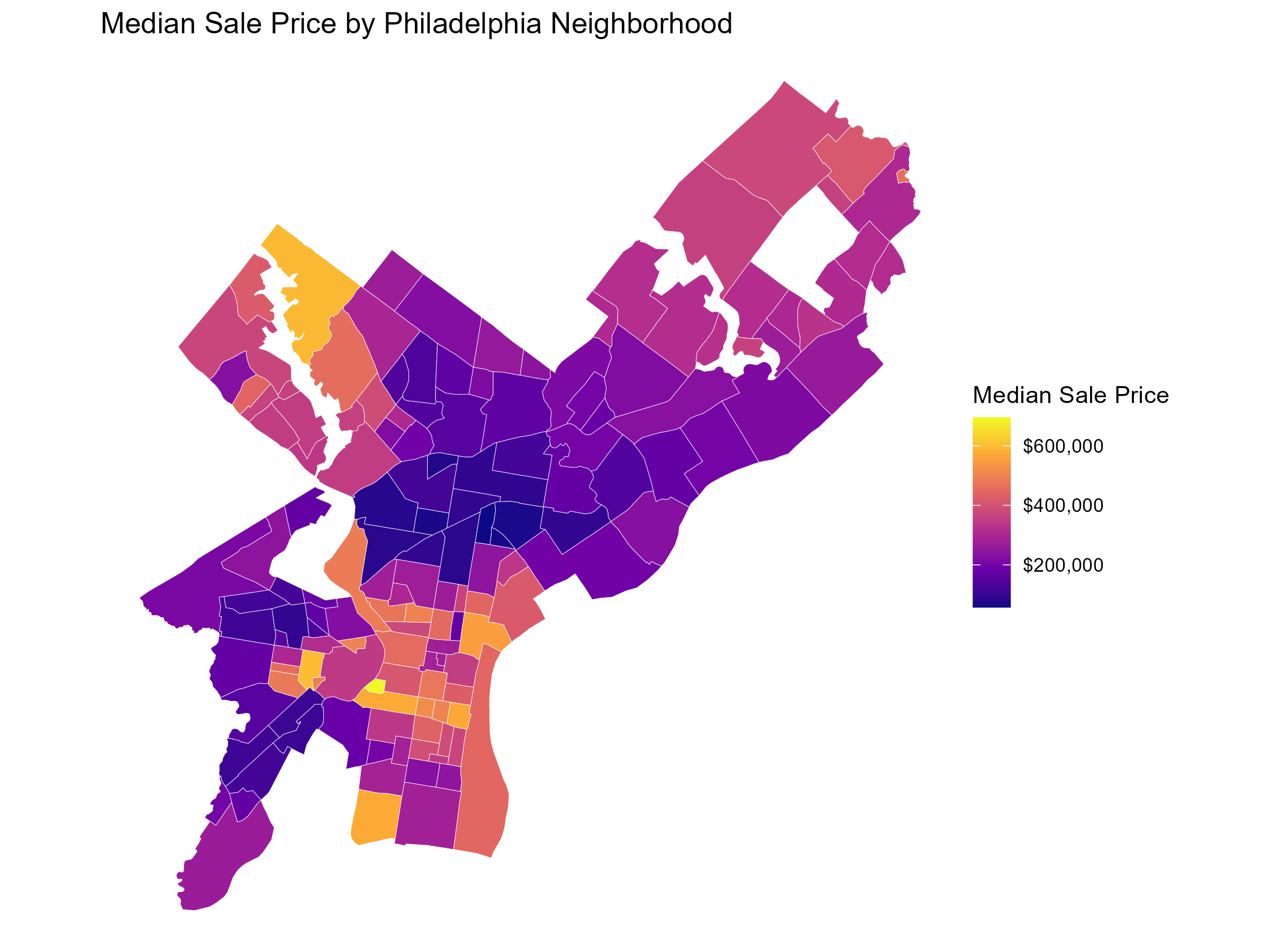
Model Building
Build models progressively:
Model 1: Structural features only
- number of bathrooms, livable area (logged), garage spaces, house age (Quadratic Effect), exterior condition
Model 2: Census variables
- median_income, percentage of bachelor, percentage of poverty
Model 3: Spatial features
- nearest college, number of nearby crime
Model 4: Interactions and fixed effects
- neighborhood wealthy (interact with livable area)
Comparison table
Model Performance Improves with Each Layer
| Model | CV RMSE (log) | R² |
|---|---|---|
| Structural Only | 0.61 | 0.35 |
| + Census | 0.50 | 0.57 |
| + Spatial | 0.49 | 0.58 |
| + Interactions/FE | 0.48 | 0.59 |
Fourth Model RMSE: $154,200
Model Validation
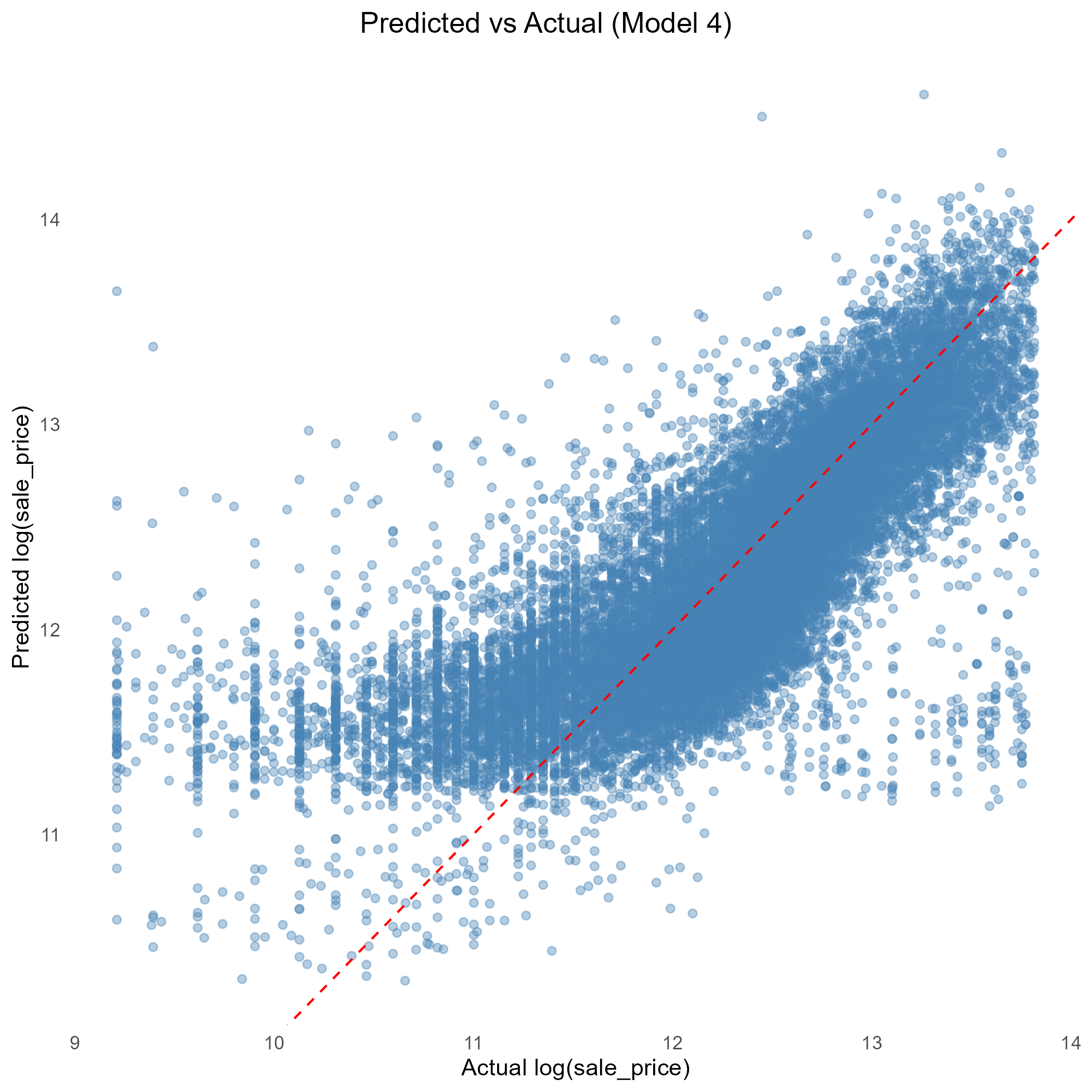
Model 4 Performance Summary
- Adjusted R² = 0.591 → explains nearly 59% of variation in sale price
- Major improvement from Model 1 (R² = 0.35) after adding neighborhood and spatial features
Key Takeaway
The final interaction model effectively captures both structural and contextual determinants of housing prices in Philadelphia, combining property-level features with socioeconomic and spatial characteristics.
Which Features Matter Most?
| Feature | Direction | Interpretation |
|---|---|---|
| Living area | ↑ | Strongest driver of housing price |
| Age + Age² | ↓ then ↑ | U-shaped pattern — older historic homes regain value |
| Exterior good | ↑ | Maintenance condition positively impacts price |
| Median income / Education | ↑ | Socioeconomic context drives demand |
| Poverty rate / Crime | ↓ | Negative neighborhood effects |
| Interaction: Living area × Wealthy neighborhood | ↓ | Larger homes add less |
Equity Concerns
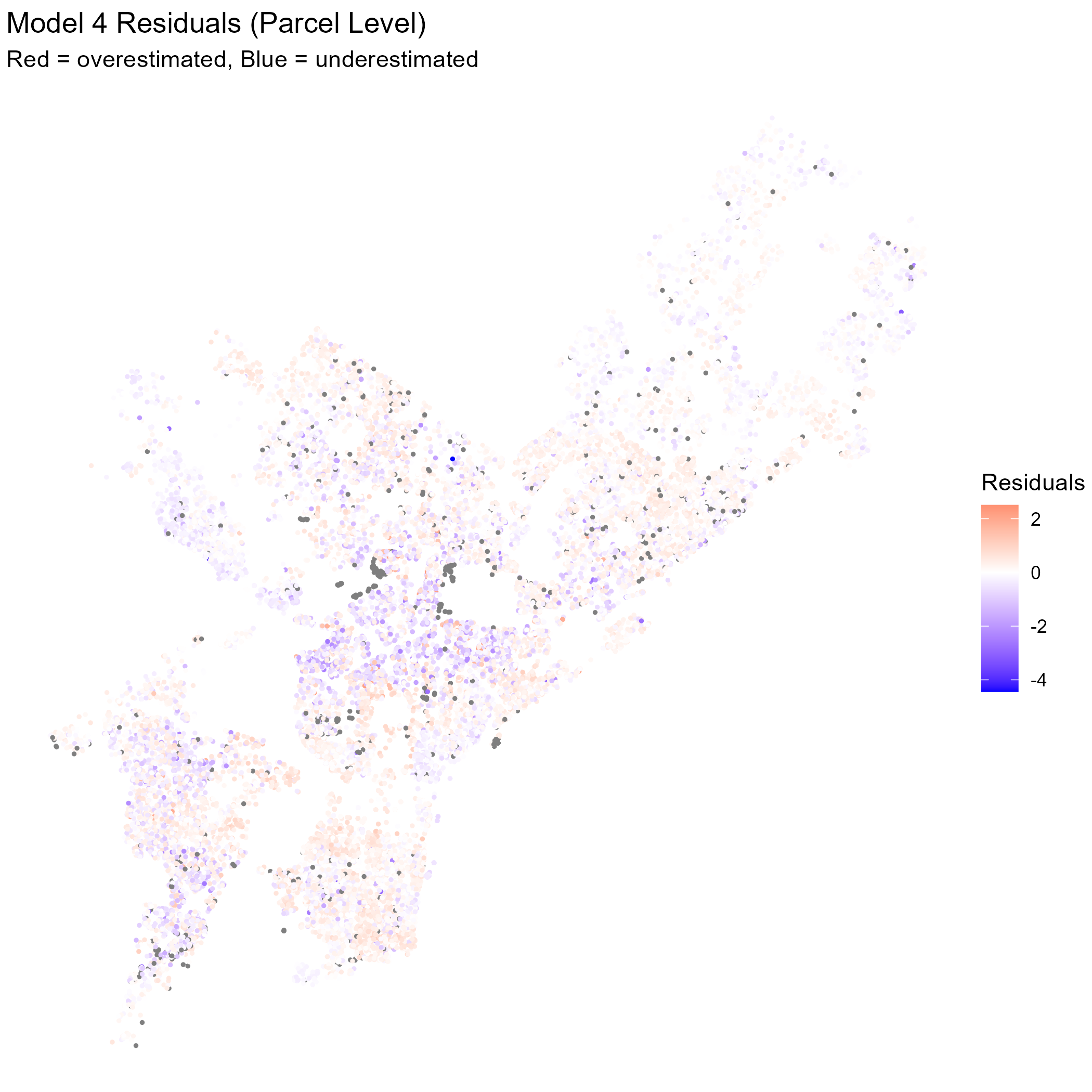
- Price determinants vary by neighborhood wealth
- Model performs best in mid-range markets, less stable in low-value areas
- Hardest Neighborhoods to predict: Nicetown, Fairhill, and Upper Kensington
- Introduce spatial autoregressive or equity-weighted models
Model Limitations and Next Steps
Key Limitations
- Spatial autocorrelation: Some clustering remains in residuals — spatial lag or error models could improve performance.
- Omitted variables: Missing data on school quality, zoning, renovation, and accessibility likely affect price variation.
- Equity bias: Predictive accuracy varies by neighborhood wealth; uniform valuation may reinforce systemic disparities.
Next Steps
- Consider other spatial features to help magnify spatial patterns
- Extend analysis with temporal dimension (panel data) to capture price dynamics over time.
Policy Recommendations
Risk of encoding structural inequalities from historical disinvestment
Introduce equity-weighted adjustments or localized calibration for underrepresented areas
Use residual maps to guide targeted reinvestment and housing policy
Conclusion
- Limitations:
- observations omitted during dating cleaning
- equity bias
Thank you for listening
Any questions?