Predicting Evictions in Philadelphia

An Early Warning System for the Housing Authority

Zhiyuan Zhao & Fan Yang

2025-12-06

The Problem

Philadelphia’s Eviction Crisis

The numbers are staggering:

  • 1,000+ eviction filings per month
  • Families lose homes, kids switch schools, credit destroyed
  • Eviction rates among highest in the nation

But many evictions are preventable — with timely intervention

The Key Question

Can we predict which neighborhoods will have the most evictions next month?

If we can identify high-risk areas before evictions happen, we can:

  • Deploy legal aid teams
  • Offer rental assistance
  • Connect tenants with resources

Goal: Intervene before the crisis, not after

Our Approach

What Data Did We Use?

Eviction Records

  • Monthly court filings
  • All 408 Census tracts
  • 2020 - 2025

Neighborhood Data

  • Poverty rate
  • % Renters
  • Median income

311 Complaints

  • No heat
  • Dangerous building
  • Infestations

Why 311? Early warning sign — tenants report problems before eviction happens

Why Monthly Data?

Metric Weekly Monthly
Zero proportion 68.4% 34%
Observations 114,534 26,082

Monthly aggregation reduces zero-inflation — creating a more tractable modeling problem while preserving meaningful variation.

Key Findings

Finding 1: Evictions Follow Clear Patterns
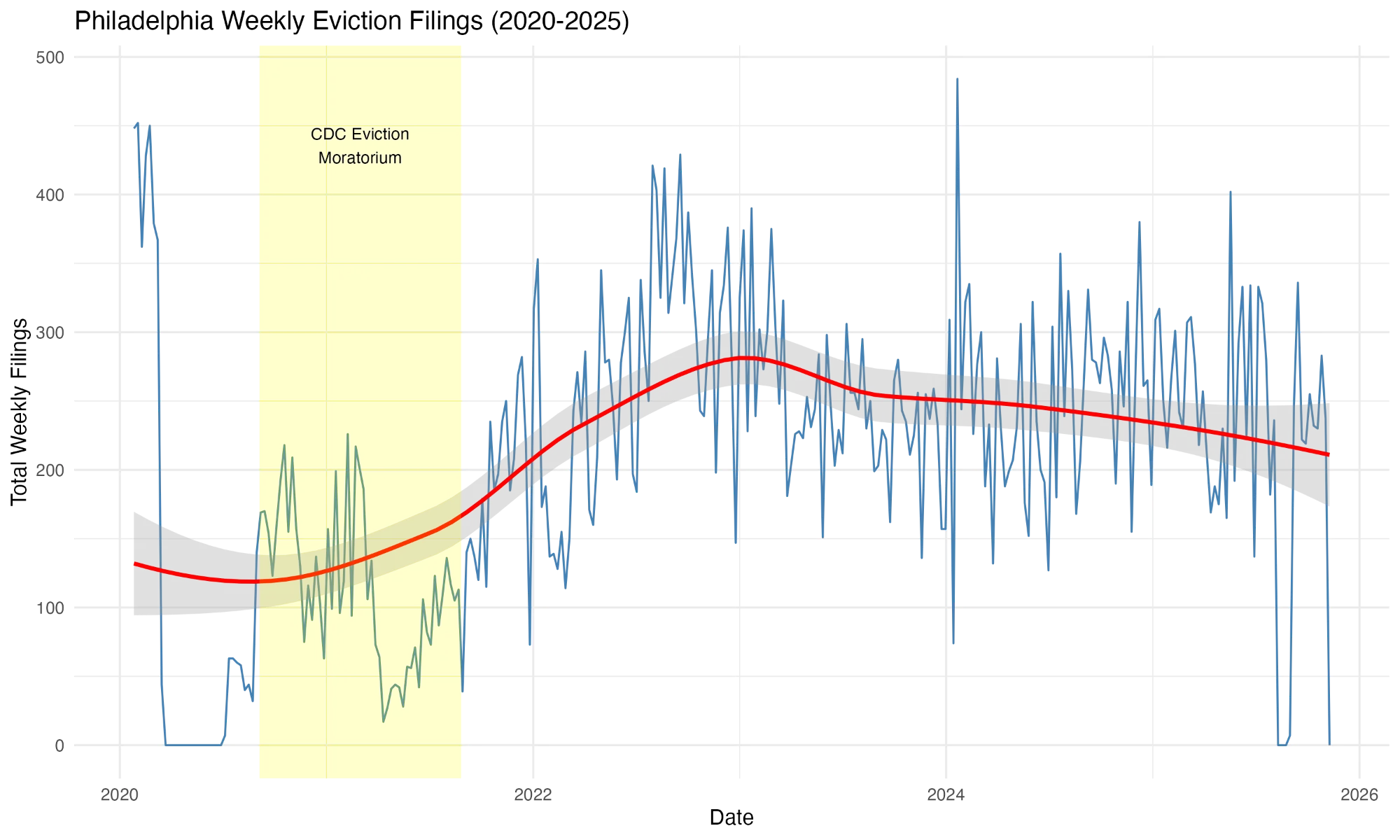
Yellow = CDC moratorium period. After it ended, evictions surged back — but predictably.

Finding 2: Geographic Clustering
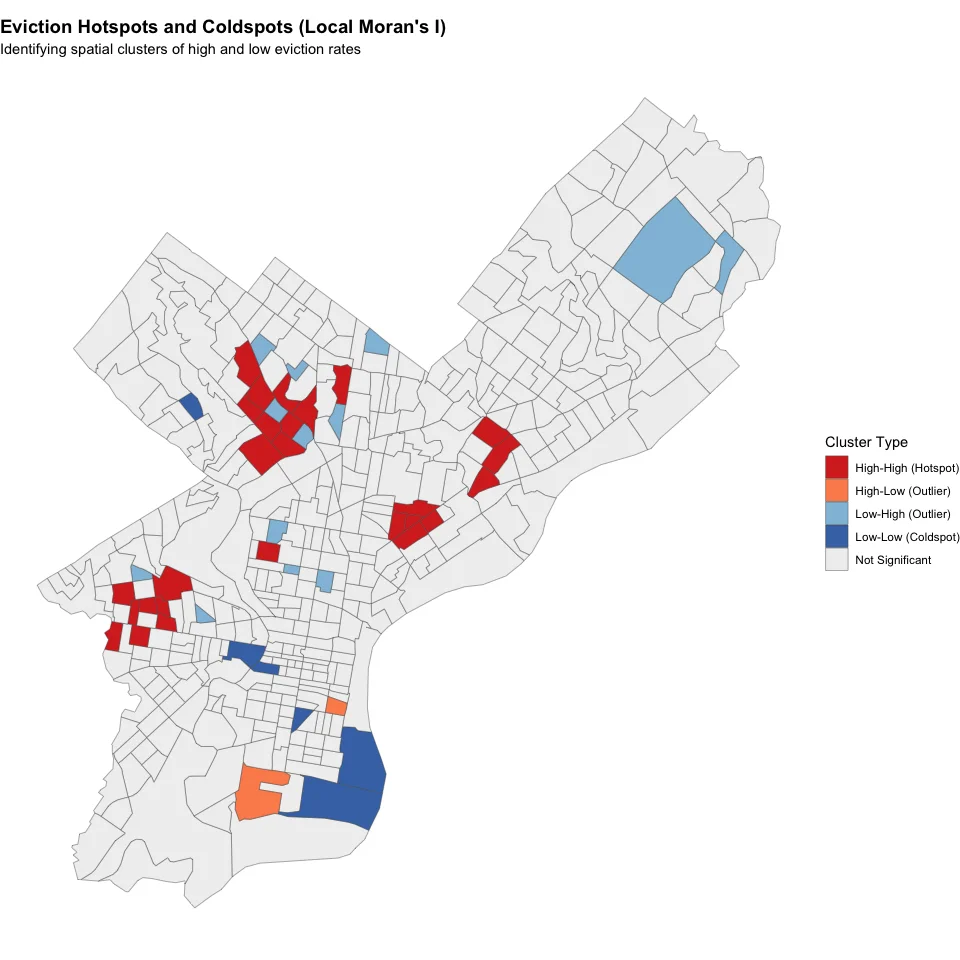
Hotspots (Red): North Philly, West Philly, Southwest | Coldspots (Blue): Center City, Far Northeast

Finding 3: Racial Disparities Exist
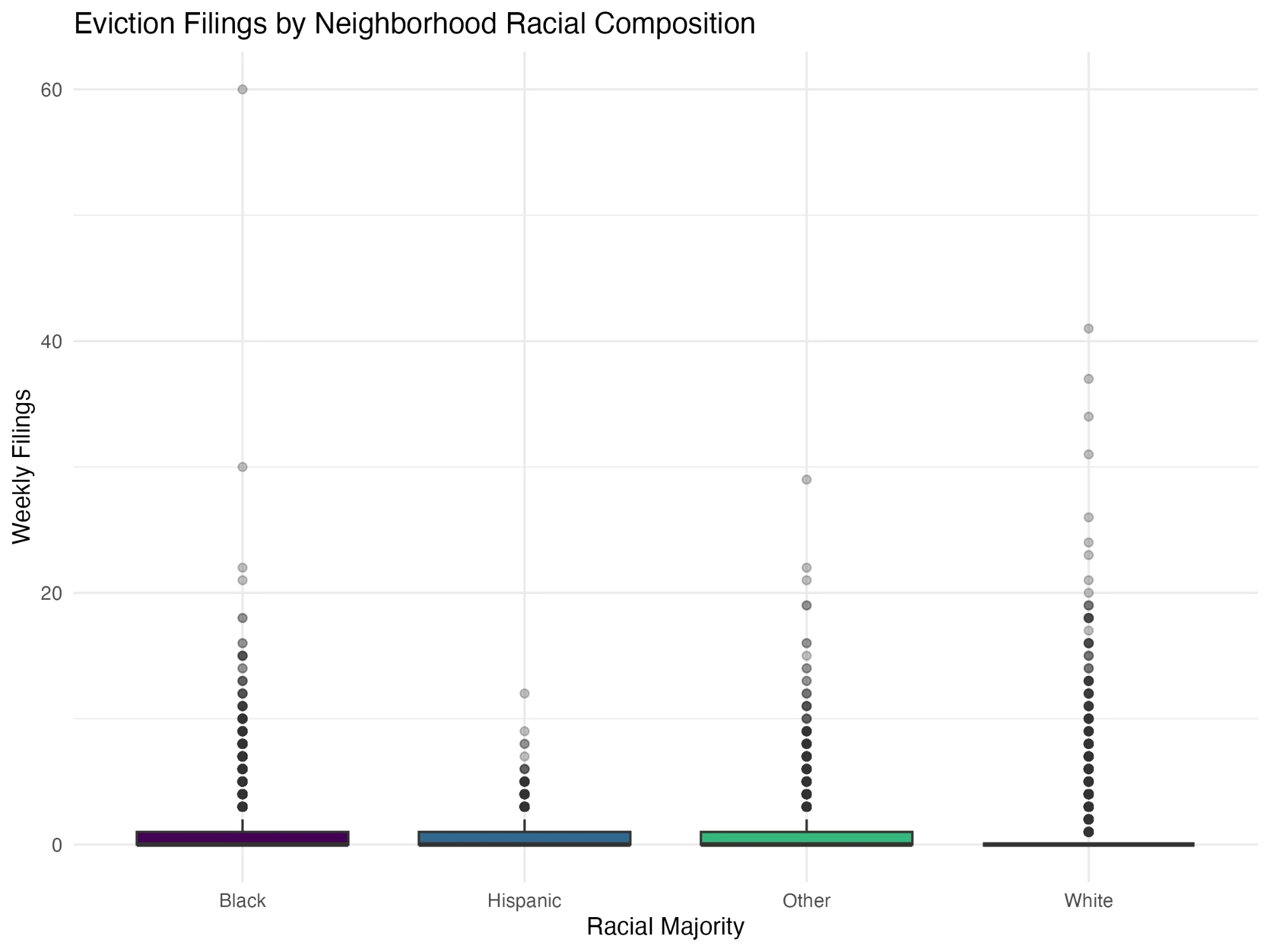
Majority-Black neighborhoods have more outliers with very high eviction counts.

Model Performance

We Tested Multiple Models

Model Variables McFadden’s R²
Baseline Last month’s evictions, 2 months ago 0.14
Full + Neighbor evictions, demographics, race 0.23
Enhanced + Hotspot features, month effects, interactions 0.24

Neighbor evictions (spatial lag): Average evictions in nearby tracts — captures “spillover effect”

Month effects: Seasonal patterns (e.g., more evictions in Jan/Feb after holidays)

Interactions: Effect of one variable depends on another (e.g., poverty has stronger effect in high-renter areas)

Model Performance on Test Set

Model MAE RMSE Correlation
Baseline 1.92 2.49 0.285
Full Poisson 1.82 2.49 0.368
Neg. Binomial 1.89 2.95 0.312
Enhanced 1.78 2.41 0.442

Lower MAE/RMSE = better. Higher correlation = better.

Actual vs Predicted: Spatial Comparison
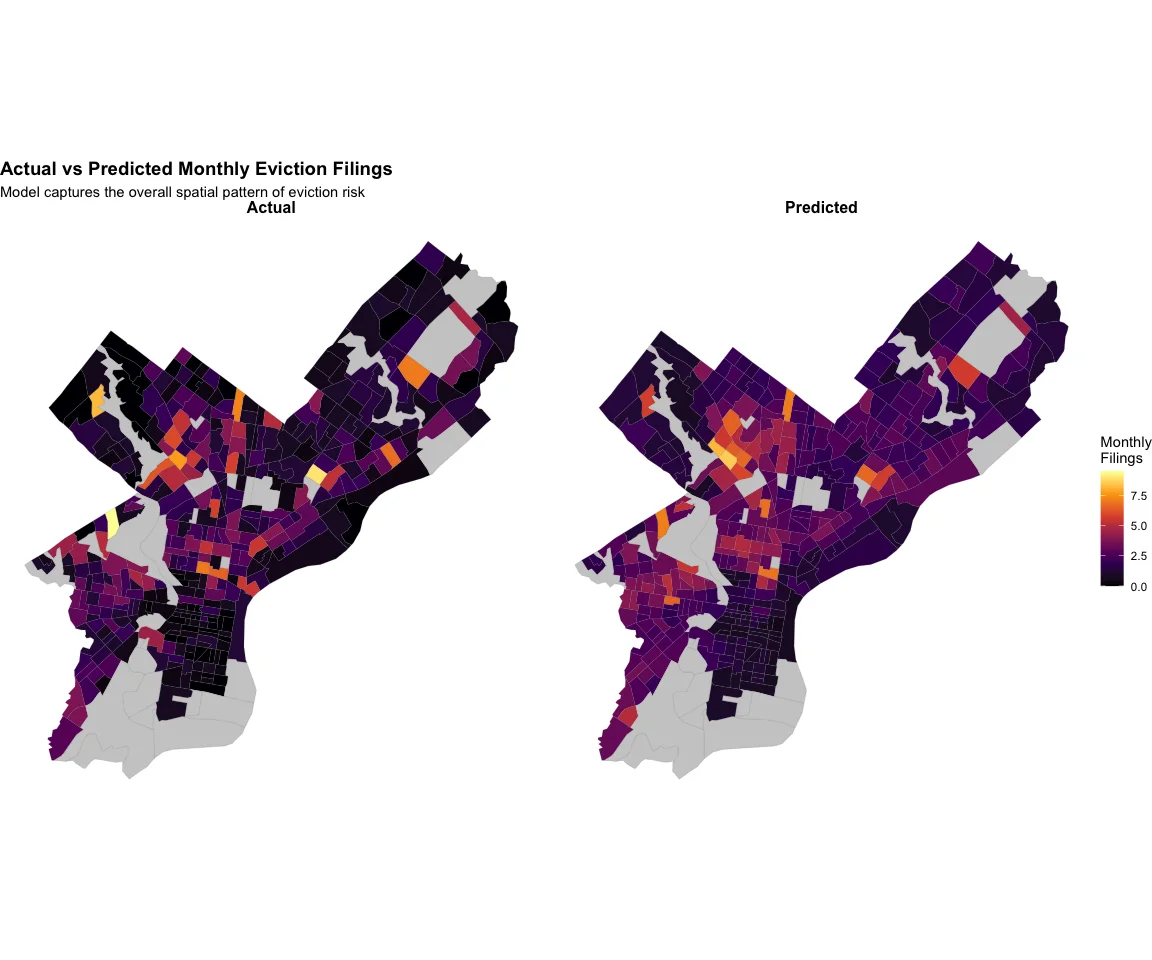
Model captures the overall spatial pattern of eviction risk across Philadelphia.

Model Residuals: Spatial Check
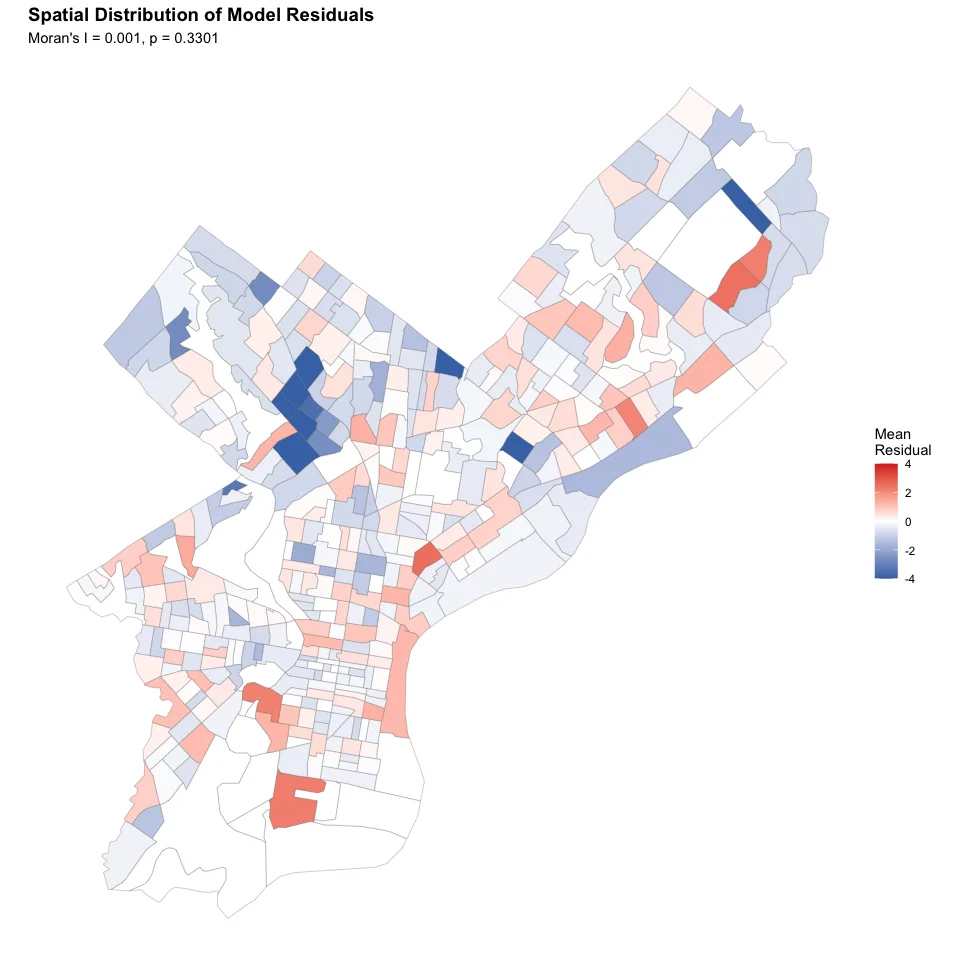
Moran’s I = 0.001, p = 0.33 — No significant spatial autocorrelation in residuals!

What This Means in Practice

We CAN:

  • Identify high-risk neighborhoods
  • Rank areas by eviction risk
  • Guide resource allocation

We CAN’T:

  • Predict exact number of evictions
  • Identify specific households
  • Predict sudden policy changes

Bottom line: Good enough to prioritize resources, not precise enough to replace human judgment

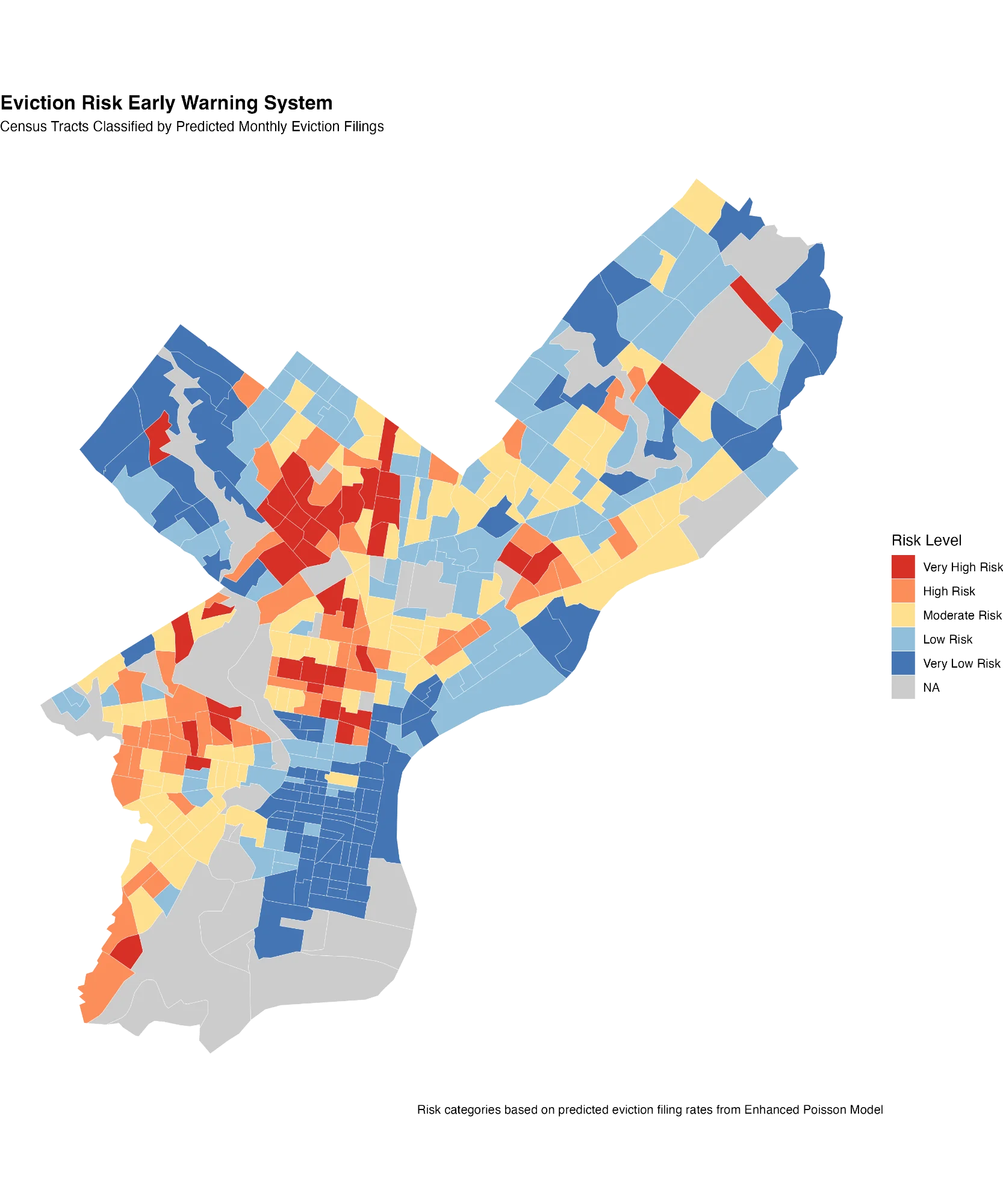
The Early Warning System

Risk Classification Map

Red/Orange areas = Priority for intervention

Equity Check: Does the Model Work Fairly?
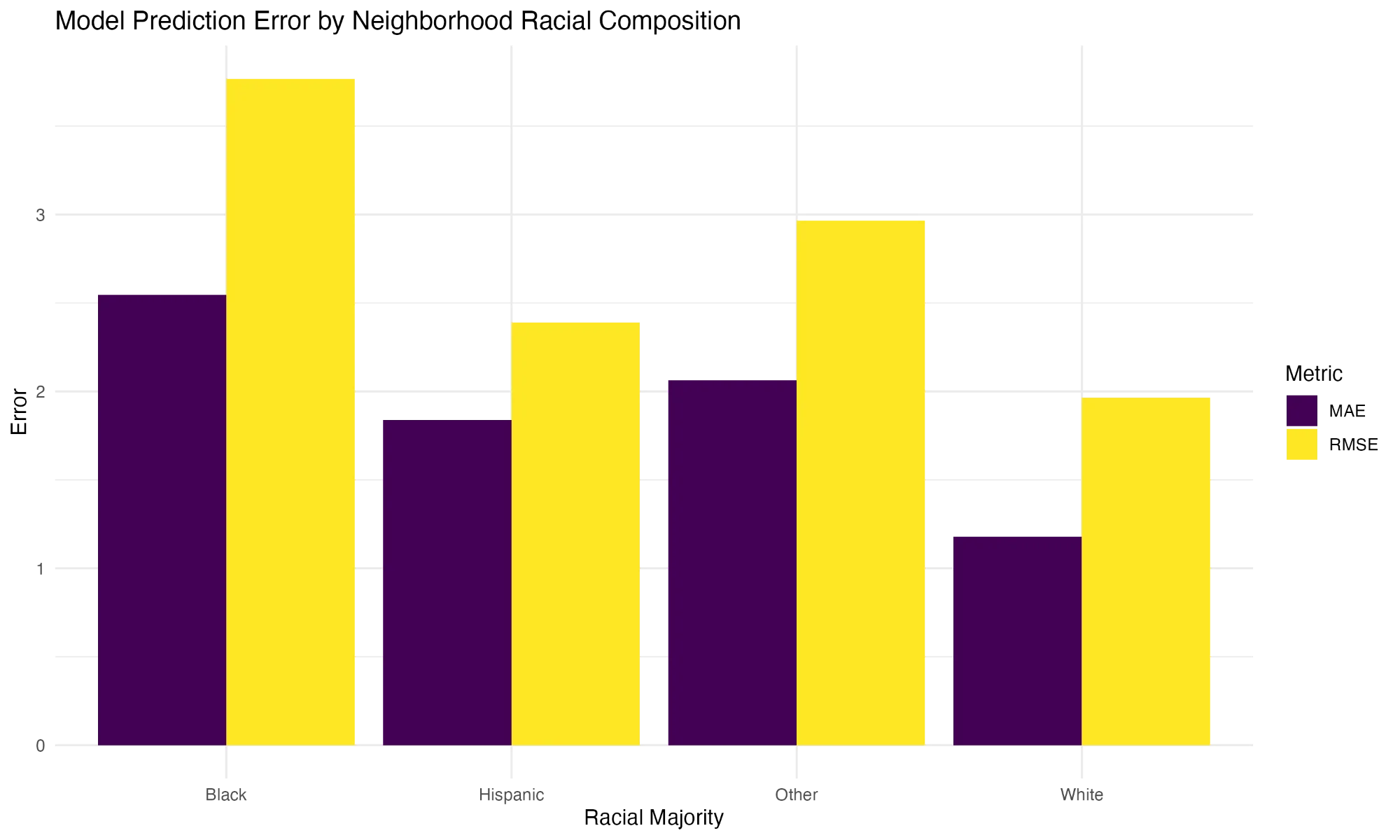
Model error is higher in majority-Black neighborhoods — we need to monitor this.

Recommendations

Three Action Steps

1. Deploy to High-Risk Areas

Use this map to send:

  • Legal aid teams
  • Rental assistance
  • Community education

2. Monitor Monthly

Update predictions to:

  • Catch emerging hotspots
  • Track intervention effects
  • Adjust as needed

3. Combine with Local Knowledge

This tool supports — not replaces:

  • Case manager expertise
  • Community input
  • On-the-ground observations

Limitations

Data & Model

  • Filings ≠ actual evictions
  • Neighborhood-level only
  • Temporal scope: 2020-2025 (COVID era)
  • Can’t predict policy shocks

Ethics & Mitigation

  • Risk of stigmatizing areas
  • Higher error in Black neighborhoods
  • Decision support, not replacement
  • Access to results should be controlled

Summary

Key Takeaways

  1. Evictions are predictable — past patterns tell us where future problems will be

  2. They cluster geographically — focus resources on hotspots

  3. Racial disparities persist even after controlling for income

  4. This tool helps prevent evictions by targeting help before the crisis

Questions?

Thank you!

Data Sources: Eviction Lab, Census ACS, Philadelphia 311